
“Your Brain on Art" Has the Science. Here Are Five Ways to Talk About It in Plain English.
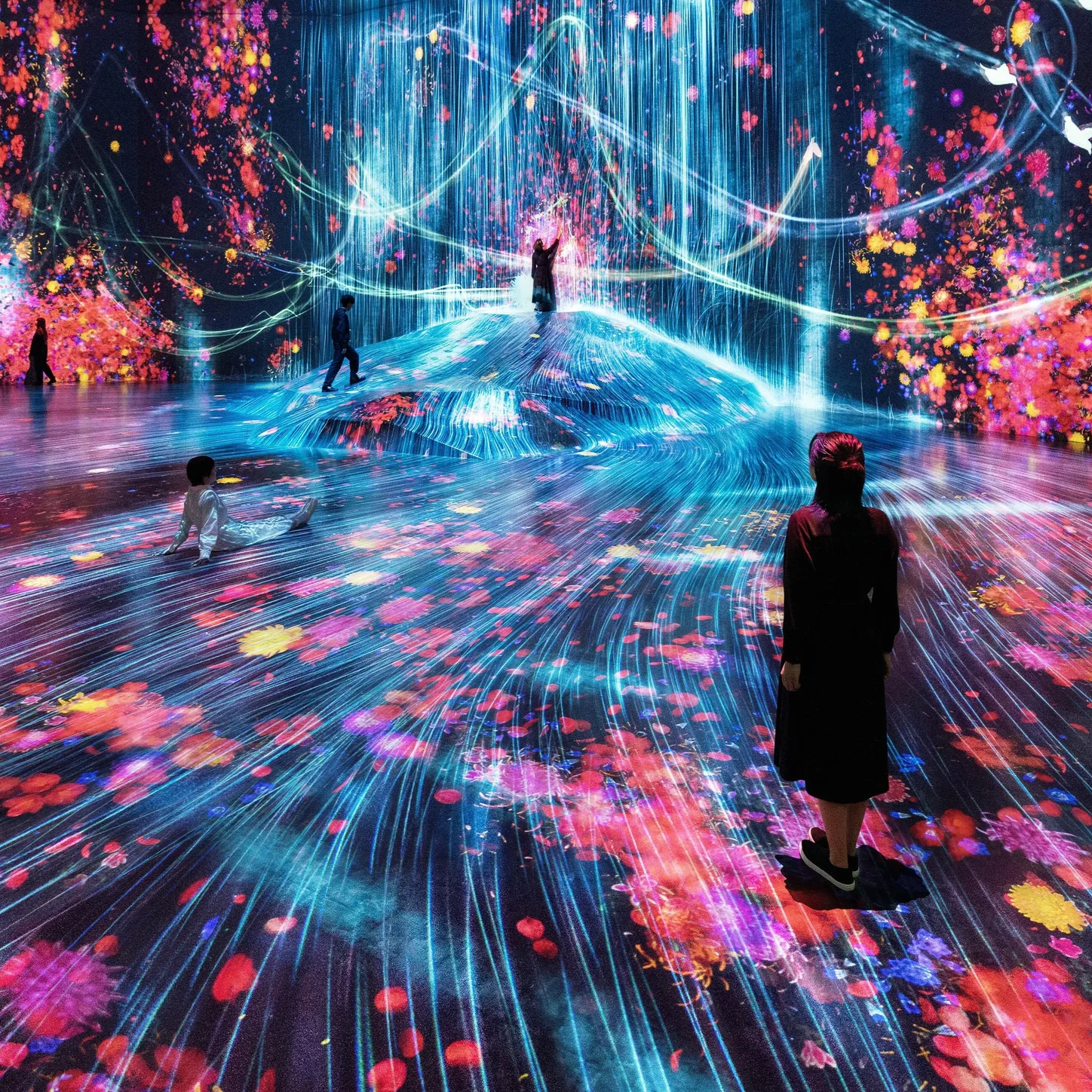
“The arts have the ability to transform you like nothing else. They can help move you from sickness to health, stress to calm, or sadness to joy, and they enable you to flourish and thrive. The arts have always offered the highest form of hope, and science is now providing new knowledge that each of us can immediately use.” - Susan Magsamen and Ivy Ross, Your Brain on Art: How the Arts Transform Us
🎨: Borderless by teamLab. Image via teamLab.
To the uninitiated, arts experiences may look like entertainment and nothing more. But those of us who have lived our lives in the arts know the transformational power of engagement with the arts, both as artists and audience members. In fact, we know it so well, it's baked so deeply in our DNA, that we have a hard time explaining it.
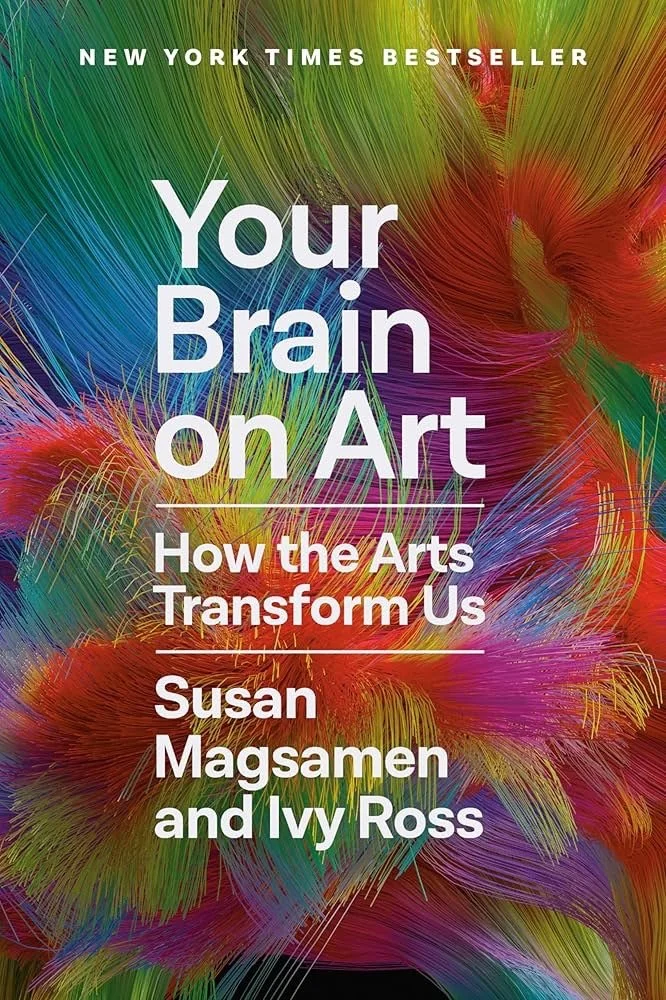
The good news is, scientists have proven what we've known intuitively our whole lives, and they have the data to back it up. Engagement in the arts has been scientifically proven to impact childhood development, academic outcomes, mental and physical wellbeing, aging, and more. In 2023, a Johns Hopkins neuroscience researcher and a Google design executive published Your Brain on Art: How the Arts Transform Us, a science-backed exploration of the healing power of art.
The book should be required reading for every arts leader trying to build new audiences. We can't expect potential audiences to read scientific studies to understand our value, any more than we can expect them to read our minds to understand how the arts have benefited us. So it's incumbent upon us to invite new people to the arts by explaining, in simple terms, the science Ross and Magsamen synthesize in their book.
I've attempted to do just that below. While some examples are written for a specific art form, a few edits will make them fit your work. I encourage you to use them however you need: as inspiration for your own messaging, something to adapt, or flat out steal. If it helps arts leaders welcome more people into their work, that's all I can ask for.
STRESSED? THERE'S AN ART FOR THAT
“The arts have the ability to transform you like nothing else. They can help move you from sickness to health, stress to calm, or sadness to joy.”
Sample Message
Life is stressful, and we're all looking for ways to find some peace in a chaotic world. Spending even a small amount of time creating art will significantly lower cortisol levels, the stress hormone in your body. It doesn't matter if you're a beginner or a pro. Sign up to get your hands dirty in our sculpting workshop, and you'll leave saying, 'Ommmm my gosh, that was fun!’
Citation: Kaimal, G., Ray, K., & Muniz, J. (2016). "Reduction of Cortisol Levels and Participants' Responses Following Art Making." Art Therapy: Journal of the American Art Therapy Association, 33(2), 74-80.
AN ARIA A DAY KEEPS THE DOCTOR AWAY
“From everyday aches and pains to serious illness, this alchemy of art and science is transforming our biology in ways that are both measurable and effective. We’re now at the point where doctors as well as social workers and public-health practitioners know enough to be able to recommend various artistic endeavors to effect beneficial outcomes for our physical and mental health. ”
Sample Message
We have a prescription for pain relief that will leave you humming. Studies show that listening to a symphony can reduce pain in daily life, whether you're suffering from a headache or a chronic condition like fibromyalgia. Come to a concert and we'll prescribe some Mozart for your arthritis or some Beethoven for your backache. We do have to warn you: this treatment can be addictive. The most common side effects include smiling, toe tapping, and waving an invisible baton.
Citations: Jenny Baxley Lee et al., "Arts Engagement to Treat Both Pain and Emotional Distress: Systematic Review and Meta-Analysis of the Literature," Palliative Medicine 35, no. 6 (December 2021)
Alexandra Linnemann et al., "The Effects of Music Listening on Pain and Stress in the Daily Life of Patients with Fibromyalgia Syndrome," Frontiers in Human Neuroscience 9 (July 2015)
TO BE (ON THE HONOR ROLL) OR NOT TO BE
“Students involved in arts are good academically. Students with access to arts education are five times less likely to drop out of school and four times more likely to be recognized for high achievement. They score higher on the SAT, and on proficiency tests of literacy, writing, and English skills.”
Sample Message
You want your kids to do well in school so they're prepared to be successful in life. You've tried tutoring, test prep, and struggled to remember your high school calculus. But have you tried 16 bars of a song from Wicked or a soliloquy from Macbeth? Performing on stage is fun, but it also builds communication, collaboration, and emotional regulation that lead to academic and life success. Our summer academy is the perfect way to set your child up for success in the coming school year.
Citation: Reed W. Larson and Jane R. Brown, "Emotional Development in Adolescence: What Can Be Learned from a High School Theater Program?" Human Development and Family Studies 78, no. 4 (July 2007)
PLIÉ YOUR WAY TO YOUR LOST CAR KEYS
“Your brain is a meaning-making machine...through highly salient experiences, like the arts and aesthetics, these quadrillions of new synapses that form in your brain create a repository of stored knowledge.”
Sample Message
Do you ever walk into a room for a very specific reason, only to stand there and wonder what you were looking for? Next time, foxtrot your way there and maybe you'll remember exactly what you need. We can teach you how. Studies show that creative dance and movement programs improve cognitive function across the lifespan and may help delay age-related cognitive decline. Join us for a ballet class, a swing dance workshop, or any of our other dance offerings. You'll have fun, get exercise, and give your brain a boost.
Citations: Yovanka B. Lobo and Adam Winsler, "The Effects of a Creative Dance and Movement Program on the Cognitive Development in Early Childhood," Review of Social Development 15, no. 3 (August 2006)
Hewston, P., Kennedy, C. C., et al. (2021). "Effects of dance on cognitive function in older adults: a systematic review and meta-analysis." Age and Ageing, 50, 1084-1092.
I GET BY WITH A LITTLE HELP FROM MY SCENE PARTNER
“Art, the researchers write, is inherently a social construct and for this reason, art engagement recruits the same brain networks as complex social behavior.”
Sample Message
Loneliness has been called the mental health crisis of our era. We are, by nature, social creatures, and we need community to thrive. But how do you find your community in a world where people are buried in their screens and struggling to find common ground? Group arts experiences like performing in your local community theatre reduce social isolation by creating face-to-face interaction, coordinated movement, and shared purpose. No experience needed to audition, and we'll be there to help you along the way. You may discover you're the next Meryl Streep. But you'll definitely have fun, find inspiration, and meet your people.
Citations: Janneke E. P. van Leeuwen et al., "More Than Meets the Eye: Art Engages the Social Brain," Frontiers in Neuroscience 16 (February 2022)
Vivek Murthy, Together: The Healing Power of Human Connection in a Sometimes Lonely World (New York: Harper, 2020)
We've always known the arts heal us. The science backs us up. Now we have the language to prove it.
